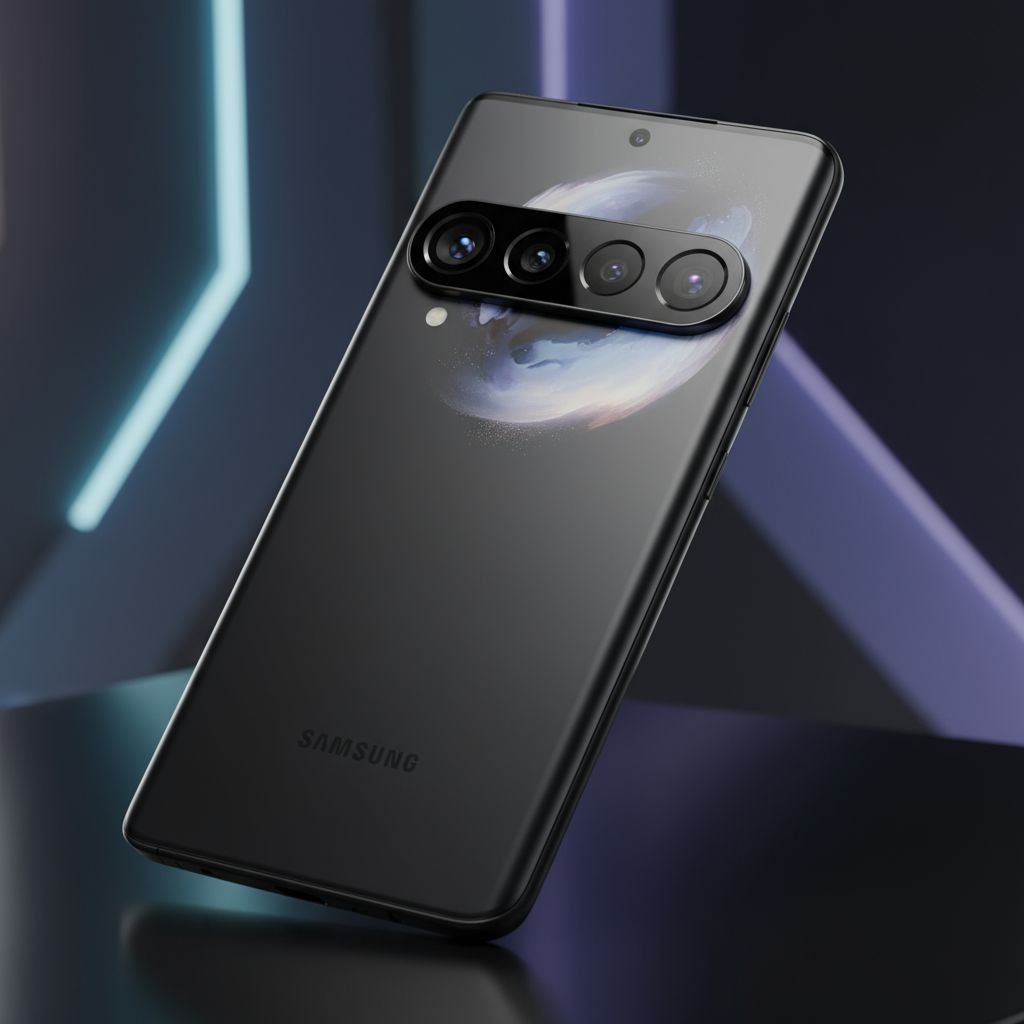
Samsung is gearing up to unleash what could be its most impressive flagship smartphone yet. The Galaxy S26 Ultra, expected to launch in January 2026, is already generating massive buzz across the tech world with leaks revealing game-changing features, cutting-edge AI capabilities, and a design refresh that signals Samsung means business.
If you've been holding onto your Galaxy S24 Ultra or debating whether to upgrade from the S25 Ultra, the S26 Ultra might just be the upgrade worth waiting for. Here's everything we know about Samsung's upcoming Android beast.
When Will the Galaxy S26 Ultra Launch and How Much Will It Cost?
Samsung is reportedly planning to unveil the Galaxy S26 series in January 2026, following its traditional launch timeline. The company may even kick off pre-orders as early as December 2025 to capture the holiday season buzz, though this would be a bold departure from its usual schedule.
Price expectations in India suggest the Galaxy S26 Ultra will start at approximately ₹1,59,990 for the base 12GB RAM + 256GB storage variant. Higher storage configurations with 512GB and 1TB options will naturally command premium pricing. While this represents a slight increase over previous generations, the hardware upgrades appear to justify the cost.
The S26 lineup will reportedly include multiple models: the standard Galaxy S26, Galaxy S26 Pro, Galaxy S26 Plus, and the flagship Galaxy S26 Ultra. There's also been chatter about a Galaxy S26 Edge variant, though recent reports suggest this model might have been cancelled.
A Design That Finally Gets It Right
After years of sticking with sharp corners that could double as paperweights, Samsung is reportedly softening the design language of the S26 Ultra with rounded corners for improved ergonomics. The phone is expected to measure just 7.9mm in thickness—nearly a full millimeter thinner than the iPhone 17 Pro Max—while somehow managing to be lighter at 232 grams compared to Apple's 233-gram flagship.
The most noticeable change? Samsung is ditching its signature floating camera island in favor of a unified oval camera module that houses the quad-camera setup. This design evolution aligns the S26 Ultra with Samsung's broader portfolio, though it does mean the camera bump will be nearly double the thickness at 4.5mm compared to the S25 Ultra's 2.4mm. The extra bulk is attributed to larger camera apertures that promise significantly better photo quality.
Color options remain somewhat mysterious, but leaks suggest a range that includes Titanium Black, Titanium Gray, and potentially a striking Orange hue that has some comparing it to the iPhone 17 Pro's Cosmic Orange. There's also talk of exclusive online colors like Titanium Violet and Titanium Yellow.
Titanium vs. Aluminum Frame Controversy
In a surprising twist, some reports indicate Samsung might ditch the titanium frame used in recent Ultra models and return to aluminum. The reasoning? Better thermal conductivity and significantly lower production costs. Titanium prices have surged, and Samsung appears to be following Apple's lead (ironically, as Apple itself switched back to aluminum for the iPhone 17 Pro).
While aluminum offers superior heat dissipation—crucial for managing the powerful chipset inside—it does come with trade-offs in durability and a slightly heavier feel. However, other sources still point to a titanium build, so the final material choice remains unclear.
Display Technology That Protects Your Privacy
The Galaxy S26 Ultra is expected to feature a 6.9-inch Dynamic AMOLED 2X display with a buttery-smooth 120Hz refresh rate. But the real headline-grabber is the rumored M14 OLED panel with CoE (Color-on-Encapsulation) technology that promises peak brightness up to 3,000 nits—a notable bump from the S25 Ultra's 2,600 nits.
The most innovative display feature, however, is the Privacy Display powered by Flex Magic Pixel technology. Think of it as a built-in privacy screen protector that you can toggle on or off at will. This feature limits screen visibility from side angles, making it nearly impossible for shoulder-surfers to peek at your sensitive information.
What makes this truly smart is the level of customization. The Privacy Display can:
Automatically activate in crowded places like public transport or elevators
Turn on for specific apps such as banking, messaging, or email
Work on a schedule during your daily commute
Include a Maximum Privacy mode that dims brightness for extra protection
This isn't just a software trick—it requires specialized hardware that uses AI to adjust pixel angles in real-time, blocking side views without affecting the main user's viewing experience. Leaks suggest this exclusive feature will only be available on the S26 Ultra, not the lower-tier models.
Chipset Wars: Snapdragon vs. Exynos Showdown
The Galaxy S26 Ultra's processor situation is perhaps the most controversial aspect of the device. For the first time since 2022, Samsung is reportedly considering bringing back the Exynos chipset to the Ultra lineup.
Snapdragon 8 Elite Gen 5: The Performance King
The Snapdragon 8 Elite Gen 5 (or Snapdragon 8 Elite 2) will power the S26 Ultra in key markets like the US, China, and Japan. Built on TSMC's 3nm process, this chip is an absolute monster:
4.74 GHz clock speed in Samsung's optimized "for Galaxy" version (compared to 4.60 GHz standard)
Over 4,000 points in Geekbench 6 single-core tests
Over 11,000 points in multi-core performance—matching Apple's A19 Pro in single-core while crushing it in multi-core
Adreno 840 GPU with 16MB of graphics memory for next-level gaming
Early benchmarks suggest the Snapdragon version will deliver a 29% single-core performance boost and 12% multi-core improvement over the previous generation.
Exynos 2600: The Dark Horse Challenger
The Exynos 2600, built on Samsung's cutting-edge 2nm GAA (Gate-All-Around) process, might actually be the more interesting story. This would make it the world's first 2nm smartphone SoC.
Leaked benchmarks paint an impressive picture:
6x faster NPU than Apple's A19 Pro for AI tasks
75% better GPU performance than the A19 Pro
14% higher multi-core CPU performance than Apple's flagship chip
30% better AI and GPU performance compared to Snapdragon 8 Elite Gen 5
If these numbers hold up, the Exynos 2600 could mark Samsung's biggest silicon comeback in years. The chip features a 10-core CPU configuration (1 ultra-fast core at 3.8GHz, 3 mid-cores at 2.96GHz, and 6 efficiency cores at 2.46GHz) and the Xclipse 960 GPU.
Which chip will you get? That depends on your region. The Snapdragon variant will likely ship to the US, China, and Japan, while Europe, Korea, and most other global markets will receive the Exynos version. Samsung has reportedly achieved 85% yield stability on the Exynos 2600, suggesting production issues that plagued earlier Exynos chips have been resolved.
Camera System: Evolution, Not Revolution
The Galaxy S26 Ultra's camera setup represents a refinement strategy rather than a complete overhaul, though some meaningful upgrades are in the works.
Quad-Camera Configuration
200MP main camera with a Sony sensor (replacing Samsung's ISOCELL HP2) and a wider f/1.4 aperture (up from f/1.7)
50MP ultra-wide camera with improved low-light capabilities
50MP periscope telephoto with 5x optical zoom (f/2.9 aperture)
10MP telephoto with 3x optical zoom (upgraded from 10MP)
12MP front-facing camera with enhanced features including 4K 120fps video recording
The star of the show is undoubtedly the main camera's f/1.4 aperture, which will allow significantly more light to hit the sensor. This translates to dramatically improved low-light photography and better depth-of-field effects. The wider aperture physically requires more depth, which explains the thicker camera bump.
Samsung is also replacing its in-house sensor with a 200MP Sony sensor, which should deliver better dynamic range and color accuracy. The camera system will support 8K video at 30fps and 4K at 120fps with advanced AI-powered image processing.
Battery and Charging: A Mixed Bag
Here's where things get disappointing. The Galaxy S26 Ultra will retain the same 5,000mAh battery capacity that Samsung has used since the Galaxy S20 Ultra in 2020. A certification from China's Quality Certification Center confirms the battery has a rated capacity of 4,855mAh (marketed as 5,000mAh typical).
This is particularly frustrating considering Chinese competitors are shipping flagships with 7,000mAh+ batteries using silicon-carbon technology. Samsung appears reluctant to adopt this newer battery tech, at least for now.
The good news? Charging speeds may finally see an upgrade:
60W wired fast charging (potentially 65W)
15W wireless charging with potential Qi2 magnetic support
Possible built-in magnets for MagSafe-style accessories
However, the Qi2 magnetic charging implementation comes with a significant caveat. Like the Pixel 10 series, built-in magnets may eliminate the Wireless PowerShare feature for reverse charging your Galaxy Watch or Buds. Current Galaxy S25 models require a magnetic case to use Qi2 accessories, and it's unclear if the S26 will have native magnetic support.
Battery life should still improve despite the unchanged capacity, thanks to the more efficient 3nm/2nm chipset, the power-optimized M14 OLED display, and One UI 8.5's AI-powered battery management.
One UI 8.5: AI Gets Smarter and More Personal
The Galaxy S26 series will ship with One UI 8.5 based on Android 16, bringing a host of new AI-powered features that make Galaxy AI feel less like a collection of tools and more like an integrated intelligence layer.
New AI Features
Meeting Assist provides real-time translation of meeting conversations and presentation screens—perfect for international business calls.
Touch Assist improves reading efficiency by intelligently processing and analyzing text displayed on your screen.
Smart Clipboard offers contextual recommendations for common actions like Summarize, Correct, Translate, Copy, and Search based on what you've copied.
Social Composer generates posts, captions, and reviews based on images you upload or purchases in shopping apps.
AI Agents Integration is perhaps the most ambitious feature. This unified launcher lets you route requests to Galaxy AI, Google Gemini, Gauss Cloud, or Perplexity from a single entry point. Instead of juggling different AI assistants, you get one shortcut that intelligently selects the right AI for each task.
Privacy and Security Enhancements
Knox Enhanced Encrypted Protection (KEEP) creates encrypted, app-specific storage environments, ensuring each app can only access its own sensitive data.
Personal Data Engine (PDE) manages your storage, app usage patterns, and network data while keeping everything secure and private.
The Network Battery Saver automatically reduces network activity and battery consumption when your phone is idle, while Intelligent Network Switch seamlessly hands off to mobile data when Wi-Fi becomes unreliable.
Samsung is also promising 7 years of software updates, meaning the S26 Ultra will receive OS upgrades and security patches until 2033.
S Pen: Curved Design, Uncertain Future
Despite rumors suggesting Samsung might ditch the S Pen entirely, recent leaks confirm it's sticking around for at least one more generation. The stylus is getting a redesigned curved top to complement the S26 Ultra's rounded corners.
However, there's a catch: the S Pen may lose Bluetooth connectivity, meaning features like Air Actions (gesture controls) might not be available. Samsung stripped Bluetooth from the Galaxy S25 Ultra's S Pen and completely dropped S Pen support from the Galaxy Z Fold 7, suggesting the company is gradually phasing out stylus functionality.
On the bright side, Samsung is reportedly developing new S Pen and digitizer technology that eliminates interference from magnetic accessories. This would allow the S26 Ultra to support magnetic Qi2 charging and other magnetic accessories without compromising S Pen accuracy—a longstanding issue for Note and Ultra users.
Why This Might Be Samsung's Most Important Flagship Yet
The Galaxy S26 Ultra arrives at a critical moment for Samsung. The company has played it safe for years, delivering incremental upgrades that rarely excited anyone. The S26 Ultra could change that narrative.
What makes it special:
Privacy Display offers functionality we've never seen in a smartphone
Exynos 2600 could finally prove Samsung's in-house chips can compete with the best
Redesigned ergonomics address long-standing complaints about sharp corners
Enhanced camera apertures promise genuine photography improvements
Seven years of updates ensure this phone stays relevant until 2033
What holds it back:
Same 5,000mAh battery feels stale compared to Chinese competitors
Material choice uncertainty (titanium vs. aluminum) creates confusion
Regional chipset lottery means not everyone gets the same experience
Qi2 implementation may sacrifice reverse wireless charging
S Pen's future remains uncertain with features being stripped away
The Verdict: A Flagship Worth the Wait?
The Samsung Galaxy S26 Ultra is shaping up as a compelling flagship that balances innovation with refinement. The Privacy Display alone could be a game-changer for business users and privacy-conscious consumers. Coupled with potentially industry-leading AI performance from either the Snapdragon 8 Elite Gen 5 or Exynos 2600, this phone promises to deliver the raw power Android enthusiasts crave.
If you're currently using a Galaxy S24 Ultra, the S26 Ultra offers enough meaningful upgrades—particularly in display technology, camera hardware, and AI capabilities—to justify the jump. For Galaxy S25 Ultra owners, the decision is tougher since many improvements are iterative rather than revolutionary.
With an expected launch in January 2026 and pre-orders possibly starting in December 2025, the wait isn't long. At ₹1,59,990, the S26 Ultra positions itself as a premium yet competitive offering against rivals like the iPhone 17 Pro Max.
Samsung appears ready to prove that Android flagships can still innovate in meaningful ways. The Galaxy S26 Ultra might just be the phone that reminds everyone why Samsung became the Android king in the first place.