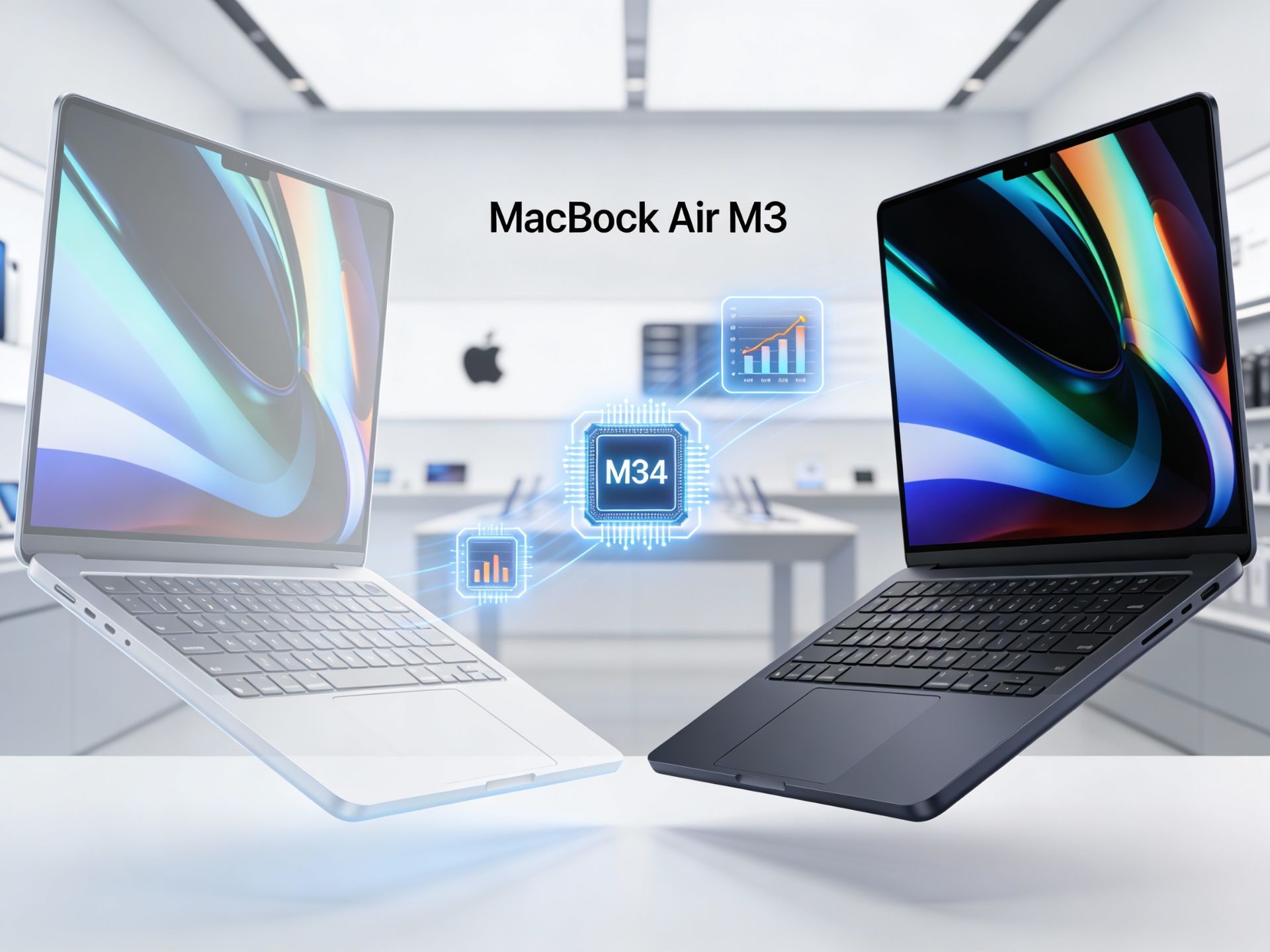
As 2025 winds down, Apple has quietly closed the book on one of its most recent MacBook lineups. The MacBook Air M3—both the 13-inch and 15-inch models—have been officially discontinued, marking the end of a product that launched just a year ago in March 2024.
But here's the kicker: this isn't about a technology failure or poor reception. It's pure Apple strategy. The M3 is being phased out because the shiny new MacBook Air M4 has arrived, and it's already setting the tone for how laptops should be spec'd at the $999+ price point.
What Just Happened: The Great 2025 Product Purge
Apple didn't announce the discontinuation with fanfare. Instead, the company quietly removed the M3 MacBook Air from its official store sometime in March 2025, alongside a massive purge of 25 devices and accessories across its entire ecosystem. In typical Apple fashion, when a newer chip comes along, the previous generation gets the axe.
The discontinuation happened in waves. The M3 MacBook Air officially disappeared from Apple's online store when the M4 variant launched on March 12, 2025. At that same moment, Apple also discontinued the M2 MacBook Air—a move that consolidated the entire MacBook Air lineup to a single generation.
Timing: Why Now?
The M3 had a relatively short shelf life—only about 11 months from launch to discontinuation. Apple launched the M3 MacBook Air in March 2024, only to replace it with the M4 model just a year later. This aggressive product cycle reflects Apple's strategy of maintaining constant innovation pressure and giving itself regular chances to improve core specs without major redesigns.
However, for consumers, this creates a peculiar situation. If you bought an M3 MacBook Air a few months ago, you're suddenly holding a device that's officially "obsolete" in Apple's eyes, even though it's still a capable machine.
The Spec Breakdown: M3 vs M4—Is the Gap Really That Big?

On paper, the jump from M3 to M4 looks impressive but not revolutionary. Here's the reality:
CPU & GPU Performance: The M4 chip features a 10-core CPU compared to the M3's 8-core design (with 4 performance + 4 efficiency cores). In real-world Geekbench 6 benchmarks, the M4 delivered a multicore score of 14,849—roughly 23% faster than the M3's 12,087. That's noticeable but not earth-shattering for everyday users.
RAM Strategy: Here's where Apple made a power move. The new M4 MacBook Air starts with 16GB of RAM as standard, while the M3 started at just 8GB. This is a bigger practical improvement than the CPU speed bump for most users. More RAM means less reliance on slower SSD swap memory, resulting in snappier performance during multitasking.
Battery Life: The M4 lasted about 30 minutes longer in Laptop Mag's web-surfing battery test (15:42 vs 15:13). Again, marginal but measurable.
Price Strategy: The aggressive price cut is the real story. Apple dropped the M4 MacBook Air starting price to ₹99,900 in India—a full ₹15,000 undercut from the M3's launch price. Even more aggressive: the M4 comes with double the base RAM while costing less. That's the kind of value proposition that makes the M3 instantly feel stale.
The Real Impact: Is Your M3 Dead?
Not even close—but it's definitely on the back foot now.
For Current M3 Owners: You're fine. The M3 remains a capable machine with years of software support ahead. Apple typically provides macOS updates for about 7-8 years from launch, meaning your M3 should stay current until at least 2031 or 2032. The M3 can handle web browsing, content creation, coding, light video editing, and casual gaming without breaking a sweat.
For Potential Buyers: This is where it gets interesting. The M3 is still available from third-party retailers like Amazon, Flipkart, and Croma, often at significant discounts. If you can snag a 16GB/512GB M3 variant at a steep discount, it's absolutely worth considering—especially if the price difference between M3 and M4 is more than ₹10,000-15,000.
However, here's the catch: the M4's value proposition is hard to ignore. At ₹99,900 with 16GB RAM, the M4 offers better longevity perception, newer hardware, and that psychological comfort of "not buying yesterday's tech".
Where You Can Still Buy the M3 (If You Want)
Apple removed the M3 from its official channels, but it hasn't vanished. Here's where to look:
Amazon & Flipkart: Regularly stock older variants with discounts
Croma, Reliance Digital: Offline and online authorized retailers still have inventory
Apple Refurbished Store: Will likely stock refurbished M3 units soon at reduced prices
Prices vary wildly, but expect to find the 13-inch M3 with 16GB RAM and 256GB storage hovering around ₹1,09,999—still about ₹10,000 more than the M4.
Apple's Broader Cleanup Strategy: Why It Matters
The M3 discontinuation is just one piece of a larger mosaic. In 2025 alone, Apple discontinued 25 products, including the iPhone SE (finally ending the Home Button era), multiple iPad models, and various MacBook configurations.
This reflects Apple's philosophy: maintain a razor-focused product lineup, push users toward higher configuration defaults (like 16GB RAM), and eliminate the confusion of too many overlapping options. It's ruthlessly efficient, and it works psychologically—fewer choices actually make the buying decision easier.
The Software Support Question
Here's something many people overlook: operating system support longevity. Apple's M-series Macs typically receive macOS updates for about 7-8 years from launch. The M3 launched in March 2024, so you should reasonably expect support through at least 2031-2032.
Compare this to older Intel MacBooks, which started losing support more aggressively. The M-series has proven to age extraordinarily well, with many users reporting that even older M1 models (from 2020) still feel snappy and responsive today.
Should You Mourn the M3's Death?
Honestly? Not really. The M3 was always positioned as a bridge generation—a incremental step between the M2 and the M4. It was good, solid, and competent, but it never had the cultural cachet of the M1 (which revolutionized MacBooks) or the marketing punch of the M4 (with Apple Intelligence features and dramatically better specs).
What matters more is what the M3's discontinuation signals: Apple is comfortable making bold pricing moves and upping the baseline specs. The M4 starting at ₹99,900 with 16GB RAM is genuinely compelling, and it shows Apple believes the M-series is mature enough to be aggressive on value.
The Bottom Line
The MacBook Air M3 is officially dead in Apple's eyes, but it's very much alive in the market. If you need a MacBook now:
Buy the M4 if you value future-proofing and the peace of mind of owning the latest generation
Hunt for M3 deals if the price difference is substantial (₹15,000+) and you're okay with slightly reduced software support runway
Consider waiting for refurbished M4 units if you can afford it—typically available 4-6 months after launch
What Apple is really saying with this discontinuation is simple: the future of MacBooks is faster, more capable, and surprisingly more affordable. The M3's exit isn't tragic—it's just inevitably replaced by something better.